Corporate social investment has totaled more than $510 billion over the past 24 years, according to the Chief Executives for Corporate Purpose (CECP) Giving in Numbers 2025. Yet demonstrating a return on that investment remains elusive. In a February 2025 survey by The Conference Board, 43% of corporate philanthropy executives identified return on investment (ROI) as their single biggest obstacle.
The difficulty is not new, and it is not marginal. A 2023 Conference Board analysis of 100 leading companies found a steep drop-off from spending to societal value to business return, a pattern that persists in the 2026 outlook where demonstrating ROI continues to continues to rank among the most-cited internal barriers.
98% report on inputs, what they spent
58% report on direct outputs, what it produced
21% report on societal outcomes
3% report on the return to the company itself
The constraint is often framed as a measurement problem. In practice, the harder challenge is aggregation. Outcomes are generated in specific places, through diverse actors, and under different reporting systems. Comparing them, combining them, and understanding what is changing at the level of where decisions are made remains difficult. The infrastructure to align them already exists and can be leveraged by corporate affairs leaders. The gap is no longer technical. It is coordination and alignment.
This raises a design question for corporate social investment. Should programs be structured to report in isolation, or alongside existing frameworks and alliance-based initiatives that pool capital around shared outcomes and enable results to be assessed singly and in aggregate?
Four industries have already done the hard part
Across four sectors with operations in Africa, Asia, and Latin America, competitors have built common reporting frameworks. Each has moved further along the spectrum from inputs to outcomes. They show that shared measurement is possible, that it can be sustained across competitors, and that it can produce comparable outcome data at meaningful scale.
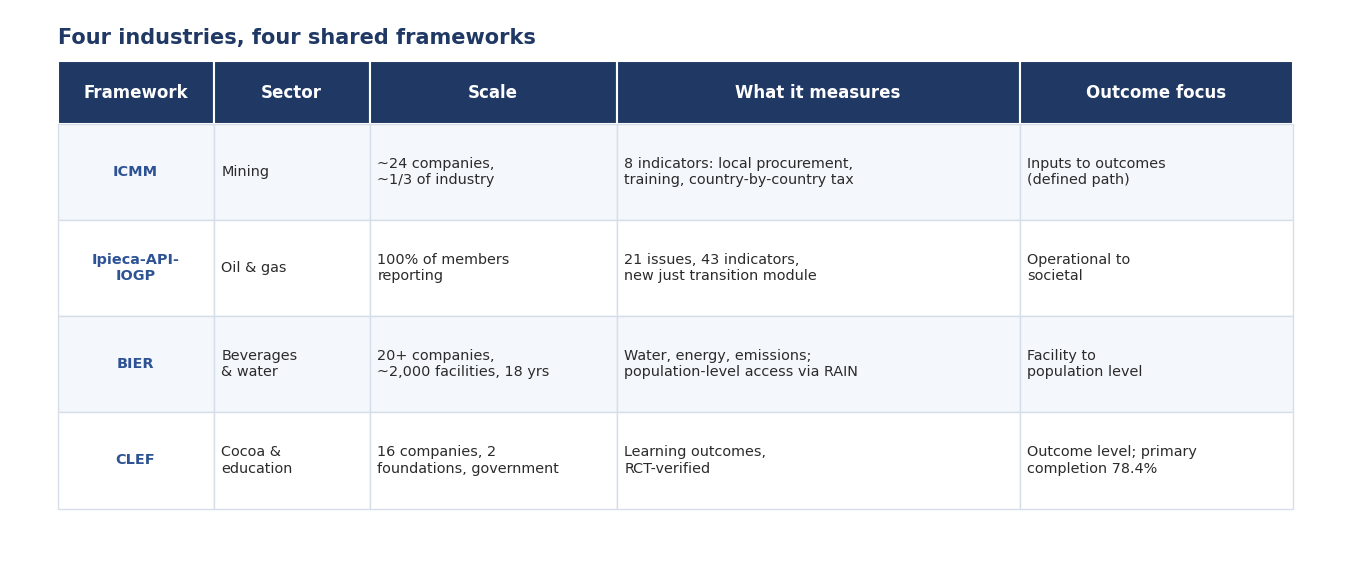
Note: Mining, oil and gas, beverages, and cocoa have each built common frameworks to measure social impact at scale. Proof that shared measurement across rivals is possible.
In mining, the International Council on Mining and Metals (ICMM) framework was explicitly designed to help members strengthen the delivery of their contribution programs and to build trust with communities, governments, and investors, with a defined path toward outcome and impact reporting. In oil and gas, recent extensions such as a new just transition module widened the lens from operational metrics toward broader societal outcomes. In beverages, the Beverage Industry Environmental Roundtable (BIER) platform enables longitudinal analysis across operations and geographies, supporting both internal benchmarking and aggregated reporting, with related initiatives like Coca-Cola’s Replenish Africa Initiative (RAIN) extending measurement to population-level access. And in cocoa, the Child Learning and Education Facility (CLEF) reached genuine outcome verification: its investment has contributed to primary completion in Côte d’Ivoire rising to 78.4%, above the Sub-Saharan average.
The significance is not any single framework. It is that competitors, in four different industries, agreed to measure the same things in the same way, sustained it over years, and produced comparable outcome data at scale. The hard part, shared measurement across rivals, has already been done four times over. The pattern across all four: the convening exists, the common framework and indicators exist across a significant African footprint.
The regional and country layer is already producing outcome data
The picture is incomplete without regional and country-rooted innovations that already generate outcome-level data at scale, close to communities.
myAgro works with more than 115,000 smallholder farmers across Mali, Senegal, Côte d'Ivoire, and Tanzania, with 50–100% increases in yields and 50%+ in farming income, 60% of them women, enabling consistent tracking of income and productivity gains at the household level across multiple countries.
SmartStart in South Africa has reached 290,000+ children and trained 24,000 early learning practitioners by 2025, with the share of children “on track” rising from 43% to 64% in eight months, enabling rapid, repeatable assessment of learning outcomes across dispersed community-based settings.
Higherlife Foundation and Delta Philanthropies, founded by Tsitsi and Strive Masiyiwa, have supported 250,000+ people with scholarships and leadership training, with $100 million invested in job creation and $60 million in healthcare and crisis response, measuring outcomes across education access, employment pathways, and service delivery, enabling multi-sector tracking of human capital development over time.
The Tony Elumelu Foundation has disbursed more than $100 million in seed capital to over 24,000 entrepreneurs across all 54 African countries, measuring business formation and growth across a continent-wide portfolio, enabling aggregation of entrepreneurship outcomes at scale.
The Aliko Dangote Foundation, endowed with $1.25 billion, spends an average of $35 million annually across health, education, and economic empowerment, generating outcome data across multiple sectors and enabling sustained tracking of impact within priority areas over time.
A foundation and one pillar are established. Corporate philanthropy is the second.
The case for corporate philanthropy is to design with the architecture that exists, in parallel, harmonizing outcomes where it is mutually beneficial. That architecture has a shape: a shared foundation of country priorities and measurement rails, with two pillars of capital rising from it. The logic of aligning ESG and corporate social investment to a shared outcomes framework is well established globally; the Sustainable Development Goals (SDGs) gave it a common reference point.
What is new is that the foundation here is country anchored. In September 2025, Ghana's President John Mahama, with former Nigerian President Olusegun Obasanjo, launched the Accra Reset at the 80th United Nations General Assembly, a framework for what comes after the SDGs, anchored in sovereignty, workability, and shared value, naming health, climate, food security, and job creation as its four investment priorities. The World Bank Group's 2024 Corporate Scorecard tracks 15 outcome areas including jobs, health, learning, and climate. Ten major multilateral development banks (MDBs), including the African Development Bank (AfDB), committed in April 2024 to harmonized impact measurement. The AfDB's own Results Management Framework 2024–2033, anchored in the High 5s including Feed Africa and Improve the Quality of Life, contributed in 2024 to 14 million people gaining healthcare access, 5 million obtaining clean water, and 260,000 direct jobs. Its Jobs for Youth in Africa strategy targets 25 million jobs and 50 million skilled youth across the continent. National compacts in health, water, and agriculture are increasingly the vehicles through which these priorities are operationalized and they are explicit invitations to corporate and philanthropic capital to align with them.
The Accra Reset’s framing of a post-SDG era, the World Bank Group Scorecard, the African Development Bank High 5s, and national compacts, together are the next-generation, country-owned expression, closer to where companies actually operate. The foundation is in place: country priorities set by African leadership, aligned to a common measurement architecture across more than 45 countries.
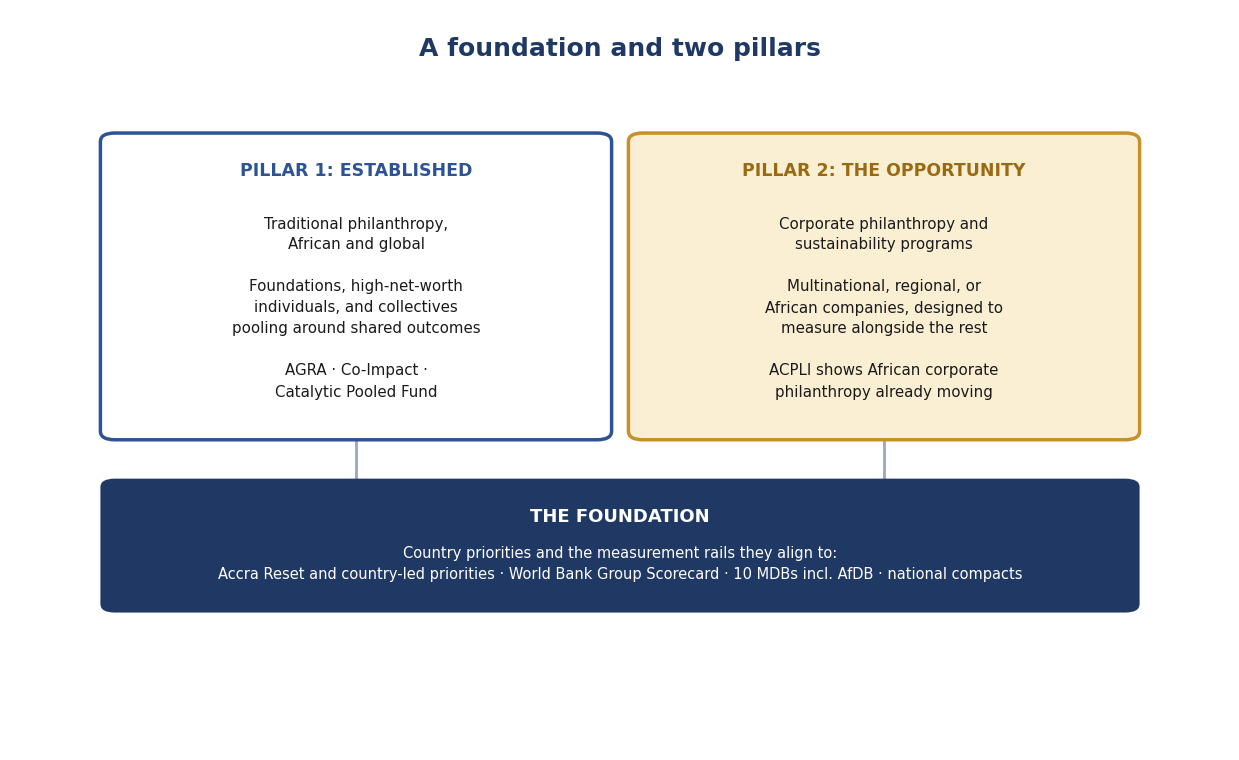
Note: One foundation. Two pillars. The first is established, the second is the opportunity.
The first pillar is established. Traditional philanthropy, African and global, has pooled capital around shared outcomes for two decades through various alliances and coalitions: the Alliance for a Green Revolution in Africa (AGRA), founded in 2006; Co-Impact, which has raised close to $1 billion; and the $200 million Catalytic Pooled Fund launched by the African Venture Philanthropy Alliance (AVPA), the Children’s Investment Fund Foundation (CIFF), and Prosper Africa. African corporate philanthropy is organizing in parallel: in May 2024 in Kigali, the Africa Corporate Philanthropy Leaders’ Initiative (ACPLI) brought together Equity Group, Safaricom, KCB, ABSA, the Tony Elumelu Foundation, Vodacom, Stanbic, Bank of Kigali, the Aga Khan Foundation, and others.
The second pillar is the one not yet aligned. Corporate social investment, delivered through corporate philanthropy and relevant sustainability goals, is substantial, but most of the $510 billion tracked has not been structured to produce outcomes that align with the pooled vehicles and the country-anchored frameworks, or to measure alongside the foundation and the first pillar. That is the gap, and the opportunity: the existing architecture can be leveraged to integrate corporate social investment into shared measurement, precisely where growth is anticipated.
The business case is converging with the opportunity
Companies will want to close that gap for business reasons:
Profit. Companies aligning business practices with corporate purpose saw a 31% rise in median pre-tax profit between 2023 and 2024, against 3% for those that did not (CECP, 2025).
Growth. The International Monetary Fund (IMF) projects sub-Saharan Africa to grow 4.4% in 2026 against a 3.1% global average, with 11 of the world’s 15 fastest-growing economies on the continent; foreign direct investment (FDI) rebounded more than 75% in 2024 to $97 billion.
Convergence. The markets where corporate giving is least integrated into shared measurement are also where global corporate growth is most likely to be found.
The point is to enable measurement both singly and in aggregate, so that a corporate water investment, a corporate philanthropic agriculture program, a multilateral health compact, and an African-led catalytic fund in the same country, say Kenya, can each be understood on their own terms, added together for the country view, and rolled up across countries to show what is changing regionally. Coordinated, not consolidated. CLEF in Côte d'Ivoire, co-financed through the Global Partnership for Education, is a pioneering example of linking corporate social impact programs with philanthropy, country priorities, and multilateral investment.
There is also a frontier worth naming. A company’s corporate philanthropy and its sustainability and access work, extending services, building distribution, developing supplier networks, and reaching underserved communities, are typically measured in separate systems, by separate teams, even when they serve the same communities. In applicable cases, aligning those outcomes may strengthen ROI.
What this means for corporate affairs and philanthropy leaders
The architecture is taking shape. At least four industries have shown shared frameworks are possible. Outcome data is already being produced at scale and also accessible through the World Bank Group Scorecard, multilateral development bank (MDB) harmonization, and the African Development Bank (AfDB) High 5s for African operations. Traditional philanthropy has benefited from these alignments.
The most useful next move is the simplest:
Map your social investments against country-level priorities, global and regional measurement frameworks.
Identify which national compacts and country programs for example in health, water, agriculture, and digital transformation intersect with where you operate.
Find the convenings where the design conversation is happening, and align or adapt measurement frameworks, with room to assess outcomes in parallel and in aggregate at the country level.
The second pillar is the opportunity. The conditions for building it are converging. Outcome data is already being produced at scale, across sectors and across countries. The constraint is not whether it can be measured. It is whether is designed to be comparable, interoperable, and aggregatable within shared frameworks. Each part of the structure holds a piece of the answer; together, bringing different forms of capital, they hold the power to design solutions through trust-based partnerships that move resources, shift systems, and scale what works
The gap is no longer technical. It is a matter of coordination and alignment. The question is whether you are inside that design conversation, or watching from the outside.